
- What Is a Letter of Introduction?
- When Should You Use One?
- What’s the Difference Between a Letter of Introduction and a Cover Letter?
- How to Write a Letter of Introduction – Step by Step
- Step 1: Research the Recipient
- Step 2: Open with Your Reason for Writing
- Step 3: Show the Value to the Reader
- Step 4: Close with a Clear Ask
- What Is the Format & Structure for a Letter of Introduction?
- Ready-to-Use Templates
- Self-Introduction Letter (Job Seeker)
- Business Letter of Introduction
- Freelancer/Contractor Introduction Letter
- Networking / Professional Introduction Letter
- Insight: Always Customize a Template
- Common Mistakes to Avoid
- How Can You Make Your Letter of Introduction Stand Out?
- What Makes a Great Letter of Introduction?
- Frequently Asked Questions
- Can you send a letter of introduction without applying for a job?
- How long should a letter of introduction be?
- Should I attach my resume to a letter of introduction?
- Who should I address a letter of introduction to?
- Can Freelancers Use a Letter of Introduction?
So you’ve met someone who could help shape your next career move. Maybe it’s a recruiter, a hiring manager, or even a potential client. They ask you to tell them a little about yourself, but even a professionally written resume created from an online resume builder may not fully explain your career goals, personality, and professional story This is when you send a letter of introduction.
Learn what a letter of introduction is, how to write one, and find ready-to-use templates for any networking situation.
What Is a Letter of Introduction?
A letter of introduction is a professional document that introduces you, your background, and your purpose for reaching out. It gives the recipient a quick overview of who you are and why they should know you.
It complements your resume by adding context that helps the recipient understand who you are beyond your qualifications.
When Should You Use One?
A letter of introduction is useful anytime you want to make a professional connection before a formal application or business relationship begins. For instance, you can send a self-introduction letter to:
- Introduce yourself to a recruiter or hiring manager.
- Reach out to a potential client or business partner.
- Expand your professional network.
- Follow up after a job application, networking event, or referral.
- Explore opportunities when no job has been advertised.
What’s the Difference Between a Letter of Introduction and a Cover Letter?
This is where a lot of job seekers and professionals get confused. Both the letter of introduction and cover letter are professional documents; they just have different purposes. Here’s a quick overview of letter of introduction vs cover letter:
| Letter of Introduction | Cover Letter |
| Introduces you to start a professional connection. | Supports your application for a specific job opening. |
| Can be sent even if no job has been advertised. | Sent only when applying for an open position. |
| Focuses on building relationships and creating opportunities. | Focuses on explaining why you’re the right fit for the role. |
| May be sent to recruiters, potential clients, business partners, or professional contacts. | Usually sent to a hiring manager or employer. |
| Can be sent with or without a resume. | Almost always accompanies a resume. |
To sum up: A letter of introduction helps you make the first connection, while a cover letter helps you strengthen your application for a specific job.
How to Write a Letter of Introduction – Step by Step
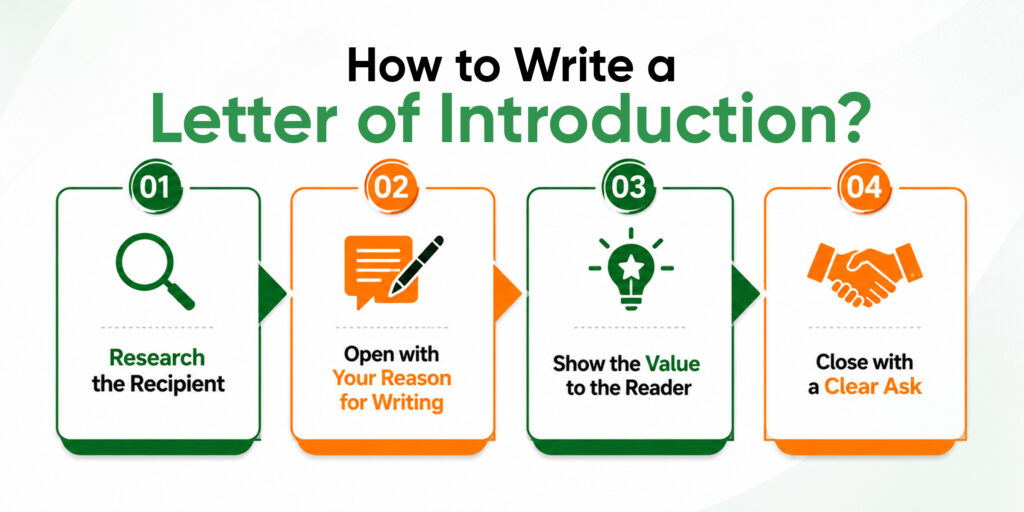
A well-written letter of introduction is clear, concise, and focused on the recipient. Follow these four steps to write one that makes a strong first impression.
Step 1: Research the Recipient
Before you start writing, learn who you’re contacting and why you’re reaching out. This will help you write a personalized letter, which goes a long way. Understand their role, company, or business to show genuine interest.
Step 2: Open with Your Reason for Writing
Start by introducing yourself and clearly explain why you’re reaching out. Keep your opening direct so the recipient immediately understands the purpose of your letter.
Quick insight: If you’re writing a letter of introduction for a job and someone referred you, mention their name in the opening sentences. This helps grab the recipient’s attention.
Step 3: Show the Value to the Reader
Highlight the skills, experience, or expertise that are most relevant to the recipient. Focus on how you can contribute instead of simply listing your qualifications.
Step 4: Close with a Clear Ask
End your letter with a specific next step, but remember to keep it low-pressure. You can request a quick call, a meeting, or invite the recipient to get in touch. Lastly, thank them for their time and sign off professionally.
What Is the Format & Structure for a Letter of Introduction?
A professional letter of introduction follows a simple structure. Including these elements keeps your message clear and easy to read. Here’s an overview:
| Section | What to Include |
| Header | Your name, email, phone number, and the date. |
| Greeting | Address the recipient by name whenever possible. |
| Introduction | Introduce yourself and explain why you’re writing. |
| Body | Briefly highlight your relevant skills, experience, or reason for reaching out. |
| Call to Action | Invite the recipient to continue the conversation or schedule a meeting. |
| Closing | Thank the recipient and end with a professional sign-off and your name. |
Aim to keep your letter to one page. Focus on the information that’s most relevant to the recipient, and avoid repeating details already covered in your resume.
Ready-to-Use Templates
Not sure where to begin? Use these templates and letter of introduction examples as a starting point. Replace each [placeholder] with your own information to personalize the letter.
Self-Introduction Letter (Job Seeker)
Use this template when introducing yourself to a recruiter or hiring manager, even if there isn’t a current job opening.
| Subject: Introduction – [Your Name] Dear [Recipient’s Name], My name is [Your Name], and I’m a [Your Profession/Current Role] with experience in [Industry or Skill Area]. I’m reaching out to introduce myself and express my interest in connecting with you.Over the past [Number] years, I’ve developed skills in [Key Skill 1], [Key Skill 2], and [Key Skill 3]. One achievement I’m particularly proud of is [Brief Achievement or Result]. I believe my background could add value to organizations like [Company Name].I’ve attached my resume for your reference and would appreciate the opportunity to connect if there are any current or future opportunities that match my experience. Thank you for your time and consideration. I look forward to hearing from you. Sincerely, [Your Name] [Phone Number] [Email Address] [LinkedIn Profile] |
Business Letter of Introduction
Use this template to introduce your company, products, or services to a potential client or business partner.
| Subject: Introduction from [Business Name] Dear [Recipient’s Name], I hope you’re doing well. My name is [Your Name], and I’m the [Your Position] at [Business Name].I’m reaching out to introduce our company and share how we help businesses with [Product, Service, or Solution]. We specialize in [Key Service], helping clients achieve [Specific Benefit or Result].Based on your work at [Recipient’s Company], I believe there may be opportunities for us to collaborate. I’d welcome the chance to discuss your goals and explore whether our services would be a good fit. Thank you for your time. I look forward to connecting with you. Best regards, [Your Name] [Job Title] [Business Name] [Phone Number] [Email Address] [Website] |
Freelancer/Contractor Introduction Letter
Use this template to introduce yourself to potential clients and showcase your expertise.
| Subject: Freelance [Your Profession] Introduction Dear [Recipient’s Name], My name is [Your Name], and I’m a freelance [Profession] specializing in [Area of Expertise].I help businesses with [Service 1], [Service 2], and [Service 3]. Recently, I worked with [Client or Industry] to achieve [Brief Result or Outcome].After learning about [Recipient’s Business], I believe my experience can support your team or upcoming projects. If you’re looking for someone with experience in [Relevant Skill], I’d be happy to discuss how I can help. Thank you for your time. I hope we have the opportunity to work together. Best regards, [Your Name] [Phone Number] [Email Address] [Portfolio Website] [LinkedIn Profile] |
Networking / Professional Introduction Letter
Use this template to build professional relationships after a referral, networking event, or mutual introduction.
| Subject: Great Connecting with You Dear [Recipient’s Name], I hope you’re doing well. My name is [Your Name], and we were connected through [Mutual Contact/Event].I currently work as a [Your Role] and have experience in [Industry or Area of Expertise]. I’ve followed your work in [Industry, Company, or Project] and wanted to introduce myself.I’d appreciate the opportunity to connect and learn more about your experience. If you’re available, I’d be happy to schedule a brief conversation at a time that’s convenient for you. Thank you for your time, and I look forward to staying in touch. Kind regards, [Your Name] [Phone Number] [Email Address] [LinkedIn Profile] |
Insight: Always Customize a Template
A template gives you the structure, but personalization is what makes your letter stand out.
Just as you tailor your resume for a job description, make sure to customize the letter of introduction to the recipient’s background. For example, a letter to a startup founder may sound more conversational, while one to a hiring manager or corporate executive should be more formal.
Common Mistakes to Avoid
Even a well-written professional introduction letter can lose its impact if it feels generic or unfocused. Before you send it, watch out for these common pitfalls:
- Using the same letter for every recipient.
- Making the letter longer than necessary.
- Repeating everything already included in your resume.
- Focusing only on yourself instead of the recipient.
- Using vague or generic language.
- Ending without a clear next step.
- Sending the letter without proofreading.
How Can You Make Your Letter of Introduction Stand Out?
A few thoughtful changes can make your letter more memorable and increase the chances of getting a response.
- Lead with a specific reason for reaching out. Explain why you’re contacting this person rather than sending a generic introduction.
- Include one memorable achievement. A measurable result or project is more convincing than a long list of skills.
- Write like a real person. Professional doesn’t have to mean robotic. Use clear, natural language.
- Show that you’ve done your homework. Referencing the company, a recent project, or a mutual connection demonstrates genuine interest.
- Leave the reader wanting to continue the conversation. Your goal isn’t to tell your entire story. It’s to earn a reply or a meeting.
Recruiters spend 6-8 seconds on the initial scan of a resume before deciding whether to continue reading. This is why sending a letter of introduction is highly recommended. That said, it’s important to personalize the letter and follow best practices to stand out.
What Makes a Great Letter of Introduction?
A great letter of introduction is clear, personalized, and written with the recipient in mind. The templates in this guide give you a solid starting point, but tailoring each letter to the opportunity is what makes it memorable.
If you want to create professional letters without starting from scratch, use Jump Resume Builder. It offers customizable templates and AI-powered writing assistance to help you create letters that make a strong first impression.
Frequently Asked Questions
Can you send a letter of introduction without applying for a job?
Yes. A letter of introduction can be sent even when there isn’t a specific job opening. It’s commonly used to introduce yourself to recruiters, hiring managers, potential clients, or professional contacts and explore future opportunities.
How long should a letter of introduction be?
A letter of introduction should usually be one page or less. Keep it concise by focusing on who you are, why you’re reaching out, and the value you can offer without repeating your resume.
Should I attach my resume to a letter of introduction?
In most cases, yes. Attaching your resume gives the recipient additional information about your qualifications. However, if you’re making an informal networking connection, you can wait until they request it.
Who should I address a letter of introduction to?
Whenever possible, address the letter to a specific person, such as a recruiter, hiring manager, business owner, or potential client. If you can’t find a name, use a professional greeting such as “Dear Hiring Manager” or “Dear Hiring Team.”
Can Freelancers Use a Letter of Introduction?
Yes. Freelancers often use letters of introduction to introduce their services to potential clients and start new business relationships before pitching a project.
- What Is a Letter of Introduction?
- When Should You Use One?
- What’s the Difference Between a Letter of Introduction and a Cover Letter?
- How to Write a Letter of Introduction – Step by Step
- Step 1: Research the Recipient
- Step 2: Open with Your Reason for Writing
- Step 3: Show the Value to the Reader
- Step 4: Close with a Clear Ask
- What Is the Format & Structure for a Letter of Introduction?
- Ready-to-Use Templates
- Self-Introduction Letter (Job Seeker)
- Business Letter of Introduction
- Freelancer/Contractor Introduction Letter
- Networking / Professional Introduction Letter
- Insight: Always Customize a Template
- Common Mistakes to Avoid
- How Can You Make Your Letter of Introduction Stand Out?
- What Makes a Great Letter of Introduction?
- Frequently Asked Questions
- Can you send a letter of introduction without applying for a job?
- How long should a letter of introduction be?
- Should I attach my resume to a letter of introduction?
- Who should I address a letter of introduction to?
- Can Freelancers Use a Letter of Introduction?