
- Can You List An Unfinished Degree?
- How To List A Degree in Progress
- How To List A Degree You Did Not Complete
- What Details Should You Include on Your Resume?
- Resume Examples For Different Situations
- Example For A Degree In Progress
- Example With Completed Credits
- Example With Relevant Coursework
- Example After Changing Programs
- How to Present Your Education on Your Resume
- Should You Explain Why You Left College?
- Top 5 Mistakes To Avoid When Listing An Unfinished Degree
- ❌ Claiming The Degree Is Completed
- ❌ Using A False Graduation Date
- ❌ Not Mentioning The Degree Is Incomplete
- ❌ Listing Irrelevant Or Excessive Coursework
- ❌ Providing Too Much Explanation About Why You Left
- How to Improve Your Education Section on Your Resume
- Final Thoughts On Listing An Unfinished Degree!
- FAQs
- Should I List Education If I Did Not Finish My Degree?
- How Should I Show an Unfinished Degree on My Resume?
- What Can I Include If I Have No Degree?
- Is Writing “Some College” Appropriate on a Resume?
- Can an Unfinished Degree Cause a Background Check Issue?
Leaving college before earning your degree can make writing your resume feel difficult. You may wonder if you should mention it at all.
The good news is that you can still include your college experience. You just need to present it clearly and honestly.
Your education may show useful coursework, skills, and progress. It can also help explain your background to hiring managers.
The right format depends on your situation. You may still be studying. Or, you might have left the program without finishing it. Understanding effective resume writing techniques can help you present your education section more clearly.
This guide explains how to list both situations. You will also see practical resume examples you can use as a starting point.
Can You List An Unfinished Degree?
Yes, you can list an unfinished degree on your resume.
The National Student Clearinghouse Research Center reports that 43.1 million people are in the “some college, no credential” category.
However, you should never make it look like you earned the qualification. Your education section should give an accurate picture of your academic history.
For example, you can include the school name, program, dates, and credits you completed. You can also add relevant coursework when it supports the job.
If you still attend the institution, show that your studies are in progress. If you left the program, clearly show the period you attended.
The goal is simple. Give employers useful information without creating confusion.
How To List A Degree in Progress
Are you currently working toward a qualification? You can include it on your resume by clearly showing that your studies are ongoing.
Include the institution, degree program, and expected graduation date. You can also mention your major, minor, relevant coursework, or academic achievements if they support your application.
For example, you can write “In Progress” or add an expected graduation date to show your current status.
Only include additional academic details if they connect with the position or strengthen your application.
How To List A Degree You Did Not Complete
Did you leave college before completing your program? You can still include that experience.
The key is to avoid words that suggest you earned the degree.
Instead, list the institution and program. Then add your attendance dates or completed credits.
For example:
Arizona State University, Tempe, AZ
Bachelor of Science in Psychology
2019–2021
Completed 72 credit hours
This format gives employers useful context. It also avoids claiming that you graduated.
You can also mention relevant coursework:
Ohio State University, Columbus, OH
Bachelor of Arts in Communication
2018–2020
Completed 60 credit hours
Relevant Coursework: Public Speaking, Media Writing, Digital Communication
This approach works well when your studies relate to the position.
What Details Should You Include on Your Resume?
You do not need to include every detail about your unfinished degree. Focus on information that helps employers understand your academic background and relevant skills.
Consider adding:
- Relevant Coursework: Include classes that match the skills required for the position.
- Academic Projects: Mention projects that demonstrate practical knowledge or experience.
- Achievements: Add strong grades, awards, or academic recognition when they support your application.
- Skills Developed: Highlight abilities gained through your studies, such as research, analysis, communication, or technical skills.
Keep your education section focused and remove details that do not add value to your resume.
Resume Examples For Different Situations
Your education entry should match your current situation. Use the format that best represents your academic progress.
Example For A Degree In Progress
University of Florida, Gainesville, FL
Bachelor of Science in Marketing
Expected Graduation: December 2027
This format clearly shows that the student is currently completing the degree.
Example With Completed Credits
University of Illinois, Chicago, IL
Bachelor of Arts in Sociology
2019–2022
Completed 84 credit hours
This version works well for someone who attended college for several years but did not complete the degree.
Example With Relevant Coursework
Penn State University, University Park, PA
Bachelor of Science in Information Technology
2018–2020
Completed 64 credit hours
Relevant Coursework: Web Development, Database Systems, Computer Networks
This approach can help when your completed classes relate directly to the job requirements.
Example After Changing Programs
University of Georgia, Athens, GA
Bachelor of Business Administration
2019–2021
Completed 70 credit hours
You do not need to explain every academic change on your resume. Keep the entry focused on your education and relevant skills.
How to Present Your Education on Your Resume
The position of your education section depends on your experience.
If you have strong professional experience, place your work history first. Then add education below it.
If you have limited work experience, your education may deserve more attention. This can help employers quickly see your academic background.
Recent graduates and current students may also place education near the top.
Your resume should highlight your strongest qualifications first.
For instance, someone with several years of relevant experience may use this order:
- Contact Information
- Professional Summary
- Work Experience
- Skills
- Education
A current student may use:
- Contact Information
- Professional Summary
- Education
- Skills
- Experience
Choose the order that best supports your application.
Should You Explain Why You Left College?
Usually, you do not need to explain why you left college on your resume.
Your resume should focus on your qualifications. It does not need a detailed explanation of personal circumstances.
An employer may ask about your education during an interview. If that happens, answer honestly and keep your response professional.
You can also highlight what you gained during your time in school. Mention useful skills, completed projects, or relevant training.
Keep the explanation brief. Then bring the conversation back to your qualifications for the role.
Top 5 Mistakes To Avoid When Listing An Unfinished Degree
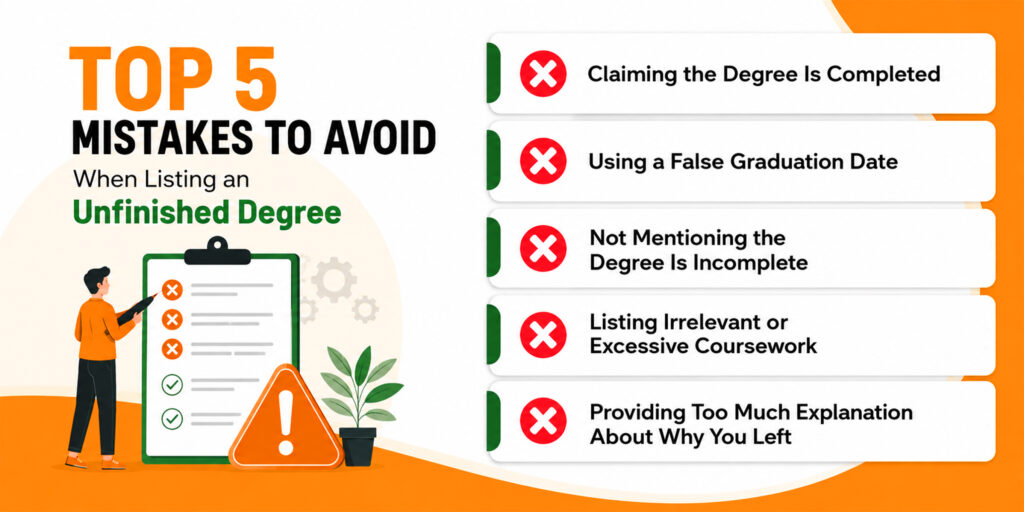
An incomplete program does not have to hurt your application. However, the wrong wording can create problems.
Avoid these common mistakes when adding your education history.
❌ Claiming The Degree Is Completed
Never list an unfinished qualification as if you graduated.
For example, do not write:
Bachelor of Science in Marketing, 2022
if you never earned the degree.
Instead, show your actual status. You can list your attendance dates or state that the program is in progress.
Honest wording protects your credibility.
❌ Using A False Graduation Date
Do not add a future or past date that suggests you received the qualification.
If you are still studying, use an expected graduation date. If you left school, list the years you attended.
For example:
Expected Graduation: May 2027
This makes your status clear.
❌ Not Mentioning The Degree Is Incomplete
An employer should not have to guess your education status.
If you are still enrolled, use terms such as “In Progress” or “Expected Graduation.”
If you left the program, show your attendance period or the credits you completed.
Clear wording prevents misunderstandings.
❌ Listing Irrelevant Or Excessive Coursework
Your resume has limited space. Do not fill it with every class you ever took.
Instead, choose courses that connect with the role.
For example, a marketing applicant may mention Consumer Behaviour or Digital Marketing. There is little value in listing unrelated classes.
Keep your academic details targeted.
❌ Providing Too Much Explanation About Why You Left
Your resume is not the place for a long personal story.
You do not need to explain family matters, financial issues, career changes, or other circumstances in detail.
Keep the education entry short. Save additional context for an interview if the hiring manager asks.
You can also review these resume mistakes to avoid in 2026 to catch other common issues before submitting your application.
How to Improve Your Education Section on Your Resume
An unfinished program does not define your entire professional background.
You can strengthen your resume by showing what you learned and how you used those skills. If you are moving into a new field, these resume tips for career changers can help you present transferable skills more effectively.
For example, mention an academic project that relates to the role. You can also highlight internships, certifications, volunteer work, or professional training.
Suppose you studied computer science but did not finish the program. You could mention a web development project or database assignment.
These details can show practical ability. They also give employers more reasons to consider your application.
Focus on skills and results. Do not let an incomplete qualification become the main story.
Formatting can also affect how employers read your resume.
Your education entries should use consistent spacing, dates, and headings. Keep each entry easy to scan.
Before submitting your application, review every education entry. Check the dates, program names, and current status.
Most importantly, make sure your resume tells the truth.
Final Thoughts On Listing An Unfinished Degree!
An unfinished degree does not mean you have nothing valuable to show.
Your college experience may include useful coursework and practical skills. Your professional experience can also carry significant value.
The key is to present your education clearly. Show your actual status and avoid misleading claims.
Use the format that matches your situation. Then focus the rest of your resume on your skills, experience, and achievements.
A clear resume can help employers understand your background without confusion. If you want an easier way to organize your education, skills, and experience, Jump Resume Builder can help you build a professional resume with a clean and structured format.
FAQs
Should I List Education If I Did Not Finish My Degree?
Yes, you can include unfinished education on your resume. It can show useful knowledge and training. Add the school, program, and relevant coursework if they support your career goals.
How Should I Show an Unfinished Degree on My Resume?
List the program, school name, location, and dates attended. If you are still studying, add “In Progress” or an expected graduation date. If you left, mention your completed coursework or credits.
What Can I Include If I Have No Degree?
Focus on qualifications that show your skills and experience. You can include work history, certifications, training, licenses, or relevant coursework. Strong achievements can also support your application.
Is Writing “Some College” Appropriate on a Resume?
It is better to give specific details than write “Some College.” Add the program, school, and credits or years completed. For example, “62 Credits Toward a B.S. in Computer Science” gives employers useful context.
Can an Unfinished Degree Cause a Background Check Issue?
Not if you describe your education accurately. Education checks can verify your school, attendance dates, and earned credentials. Problems can arise if you claim a degree you did not earn.
- Can You List An Unfinished Degree?
- How To List A Degree in Progress
- How To List A Degree You Did Not Complete
- What Details Should You Include on Your Resume?
- Resume Examples For Different Situations
- Example For A Degree In Progress
- Example With Completed Credits
- Example With Relevant Coursework
- Example After Changing Programs
- How to Present Your Education on Your Resume
- Should You Explain Why You Left College?
- Top 5 Mistakes To Avoid When Listing An Unfinished Degree
- ❌ Claiming The Degree Is Completed
- ❌ Using A False Graduation Date
- ❌ Not Mentioning The Degree Is Incomplete
- ❌ Listing Irrelevant Or Excessive Coursework
- ❌ Providing Too Much Explanation About Why You Left
- How to Improve Your Education Section on Your Resume
- Final Thoughts On Listing An Unfinished Degree!
- FAQs
- Should I List Education If I Did Not Finish My Degree?
- How Should I Show an Unfinished Degree on My Resume?
- What Can I Include If I Have No Degree?
- Is Writing “Some College” Appropriate on a Resume?
- Can an Unfinished Degree Cause a Background Check Issue?