- Does a Cover Letter Still Matter in 2026
- What Things You Need to Know Before Writing a Cover Letter
- Read the Job Description Carefully
- Research the Company Before You Apply
- Find the Hiring Manager’s Name
- Identify the Most Important Keywords
- Check the Recommended Cover Letter Length
- The Structure of an Effective Cover Letter
- Header
- Greeting
- Opening Hook
- Body Paragraphs
- Closing Paragraph
- Sign Off
- Example Cover Letters by Situation
- Entry Level Applicant
- No Experience
- Employee Referral
- Career Changer
- Applicant With a Resume Gap
- Internal Promotion
- Remote Role Application
- Match Your Tone to the Industry
- Traditional and Corporate Fields
- Tech and Startups
- Creative and Marketing Roles
- Service and People-First Roles
- Writing for AI Screening and Applicant Tracking Systems
- How to Use AI Tools to Draft Your Cover Letter (Without Sounding Like a Bot)
- Common Mistakes to Avoid
- Quick Checklist Before You Hit Submit
- Conclusion
- Frequently Asked Questions
- Is a cover letter still necessary in 2026?
- How long should a cover letter be?
- What should you say if you have a resume gap?
- Do cover letters get read by AI?
- How do you address a cover letter without a hiring manager name?
A lot of job seekers wonder if a cover letter even matters anymore. Hiring today looks different than it did a few years ago. Many companies now use software to scan applications before a real person ever sees them.
That change makes some people think cover letters are pointless. The opposite is true. A strong cover letter still helps you stand out, and it plays a specific role that your resume cannot fill on its own. Pairing it with an AI free resume builder can help you put together both documents without extra cost or hassle.
This guide walks you through exactly how to write one in 2026. You will get a clear structure, real examples for different situations, and tips on writing for both people and screening software.
Does a Cover Letter Still Matter in 2026
Yes, a cover letter still matters. Many hiring managers say a strong cover letter can influence whether they move a candidate forward, even when the resume alone is only average.
Your resume lists what you have done. Your cover letter explains why it matters for this specific job. That difference is still valuable, no matter how much technology gets involved in hiring.
According to the National Association of Colleges and Employers (NACE) Job Outlook 2026 Spring Update survey, 72% of employers look for strong written communication skills on resumes. A well-written cover letter gives candidates another opportunity to demonstrate those communication skills while explaining why they are the right fit for the role.
Some companies skip reading cover letters for every applicant. Others read every single one. Since you rarely know which type of company you are applying to, skipping the cover letter is a risk you do not need to take.
What Things You Need to Know Before Writing a Cover Letter
A little preparation makes writing your cover letter faster and more effective. Do not skip these steps.
Read the Job Description Carefully
Review the job posting and highlight the required skills, qualifications, and responsibilities. This helps you tailor your cover letter to the role.
Research the Company Before You Apply
Spend a few minutes on the company website. Learn about its mission, values, recent news, or products so you can personalize your letter and match its tone.
Find the Hiring Manager’s Name
Check the job posting first. If no name is listed, look on the company website or LinkedIn. If you still cannot find one, use a professional greeting instead.
Identify the Most Important Keywords
Note the key skills and qualifications mentioned in the job description. Include relevant keywords naturally to show your fit for the role.
Check the Recommended Cover Letter Length
Some job postings specify a preferred length. If they do not, aim for 250 to 350 words, or about half to one page.
The Structure of an Effective Cover Letter
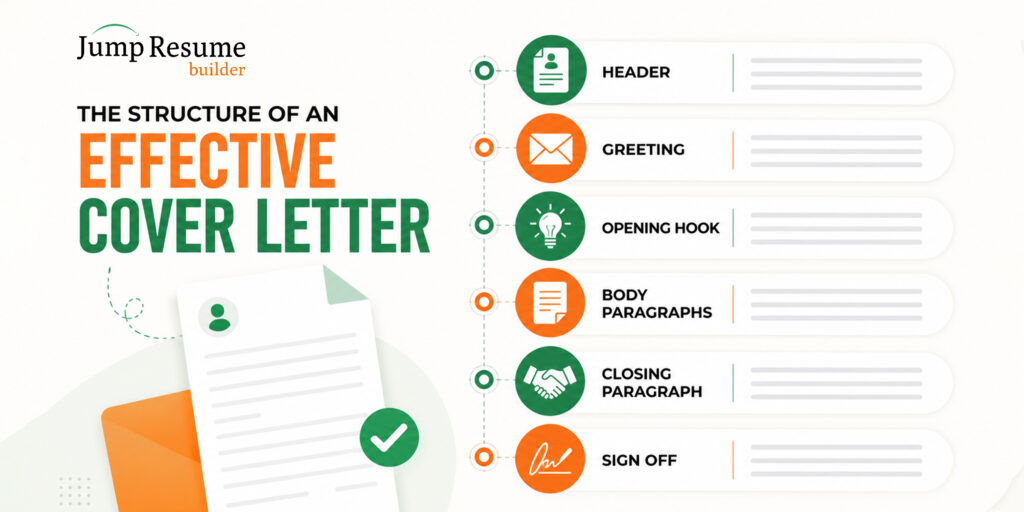
Every strong cover letter follows the same basic shape. Here is each part explained.
Header
Include your name, phone number, email, and city at the top. Add the date and the company name below that.
Greeting
Address the hiring manager by name whenever possible. If you truly cannot find one, use a role based greeting such as “Dear Hiring Manager” or “Dear Marketing Team.”
Opening Hook
Skip the tired opening line that just repeats the job title. Instead, open with a specific accomplishment or a genuine reason you want this role.
- ❌ Don’t: “I am writing to express my strong interest in applying for the open Marketing Coordinator position at your company.”
- Do: “When I scaled my university’s event engagement by 40% in one semester, I realized my passion for community-driven marketing, which is why I am excited to apply for your Marketing Coordinator role.”
Body Paragraphs
Use one or two paragraphs here. Connect your experience directly to what the job posting asks for, using a real example or result each time.
Closing Paragraph
Restate your interest in the role. Mention what you would bring to the team in your first few months.
- ❌ Don’t: “Thank you for your time. I hope to hear from you soon regarding an interview.”
- Do: “I would love the opportunity to discuss how my background in lead generation can help your sales team hit its Q3 goals. Thank you for your time and consideration.”
Sign Off
End with a simple, professional line such as “Sincerely” or “Best regards,” followed by your full name.
Your cover letter works best when it complements a well written resume rather than repeating it. If you still need to create or improve your resume, explore our Bad Resume Examples: 15 Mistakes That Can Cost You the Job to avoid common mistakes before you apply.
Example Cover Letters by Situation
Generic examples rarely help you write your own letter. These seven examples reflect real situations job seekers face.
Entry Level Applicant
| Dear Ms. Rivera, As a marketing student who managed social media for two campus organizations, I grew combined engagement by 40 percent in one semester. I am excited to bring that same energy to the coordinator role at Brightline Media.During my internship at a local nonprofit, I learned how to plan content calendars and report on results, skills I know your team values based on your recent job posting.I would welcome the chance to bring fresh ideas and steady effort to your marketing team. Thank you for considering my application.Sincerely, Jordan Ellis |
No Experience
| Dear Hiring Manager, I am excited to apply for the Administrative Assistant position at GreenTech Solutions. Although I am entering the workforce for the first time, I have developed strong communication, organization, and teamwork skills through academic projects and volunteer work.I am eager to learn, take on new responsibilities, and contribute to your team. My positive attitude, willingness to grow, and ability to adapt quickly make me confident I can succeed in this role. Thank you for considering my application. I would welcome the opportunity to discuss how I can contribute to your organization. Sincerely, Taylor Brooks |
Employee Referral
| Dear Ms. Johnson, I am writing to apply for the Sales Executive position at Horizon Solutions after being referred by your Account Manager, Daniel Carter. He encouraged me to apply because of my experience in sales and client relationship management.In my previous role, I consistently exceeded sales targets by building strong client relationships and identifying new business opportunities. I am excited about the opportunity to bring the same results and enthusiasm to your team. Thank you for your time and consideration. I look forward to discussing how I can contribute to Horizon Solutions. Best regards, Morgan Lee |
Career Changer
Tone Tip: If pivoting into corporate or finance, keep this letter strictly formal. If pivoting into tech or startups, focus more on agile problem-solving and rapid learning.
| Dear Mr. Patel, After eight years in retail management, I am moving into project coordination, a shift that builds directly on skills I already use every day. Managing staff schedules, budgets, and vendor relationships taught me how to keep complex operations running smoothly.I recently completed a project management certification to strengthen the technical side of this transition. I am ready to apply the organizational skills I built in retail to a new industry. I would love to discuss how my background could support your team’s upcoming projects. Best regards, Samira Cole |
Applicant With a Resume Gap
Tone Tip: For creative and tech roles, emphasize self-driven learning or contract work during your gap. For traditional industries, keep the explanation direct, brief, and professional.
| Dear Hiring Manager, I took eighteen months away from full time work to care for a family member, a decision I do not regret and one that taught me patience and resilience. During that time, I completed two online courses in data analysis to keep my skills current.I am now ready to return to full time work with fresh focus and updated technical skills. My previous role as a data assistant showed strong attention to detail, something this position clearly requires. I appreciate your consideration and would welcome a conversation about how I can contribute. Sincerely, Devon Marsh |
Internal Promotion
| Dear Ms. Chen, Over the past three years on the customer support team, I have consistently exceeded satisfaction targets while also training four new hires. I am applying for the team lead position because I want to take on more responsibility within a company I already believe in.I understand our current workflow and challenges firsthand, which means I could step into this role with less ramp up time than an outside hire. I have already started shadowing our current team lead to prepare. Thank you for considering me for this next step. Best regards, Priya Nair |
Remote Role Application
| Dear Hiring Manager, I have worked remotely for three years as a customer success specialist, managing accounts across four time zones without missing a deadline. I use clear written communication and reliable daily check-ins to keep remote teams aligned.Your job posting mentioned a fully distributed team, which matches how I already work best. I have my own dedicated home office setup and a strong track record of staying productive without in person supervision. I would welcome the opportunity to bring that same reliability to your team. Sincerely, Marcus Webb |
Pairing a strong cover letter with a tailored resume gives you the best chance of getting noticed. If you need inspiration, explore ATS friendly resume examples across different industries and experience levels to create a matching application.
Match Your Tone to the Industry
Your life situation dictates what story you tell, but your target industry dictates how you tell it. A career changer applying to an AI startup needs an entirely different tone than someone applying to a corporate law firm. Aligning your writing style with your target field makes your application feel natural and intentional.
Traditional and Corporate Fields
For roles in finance, law, healthcare, or government, keep your tone strictly formal and structured. Focus your language on compliance, risk management, and measurable results.
Tech and Startups
For technology, product, and startup roles, adopt a direct and outcome-focused tone. Highlight your adaptability, speed, and comfort with modern tools rather than rigid processes.
Creative and Marketing Roles
For design, writing, or agency positions, use a conversational and engaging voice. Let your brand awareness and storytelling skills show through while keeping the focus on your portfolio.
Service and People-First Roles
For customer support, nursing, retail, or HR, use a warm and empathetic tone. Emphasize emotional intelligence, team collaboration, and client satisfaction metrics.
Writing for AI Screening and Applicant Tracking Systems
Many companies now use software to scan applications before a human reads them. This does not mean you should write for a robot instead of a person. It means you should write clearly enough that both can follow it.
Use the exact keywords and phrases from the job posting where they genuinely apply to your background. If the posting says “project management,” use that exact phrase rather than a synonym like “leading initiatives.”
Keep your formatting simple. Avoid text boxes, tables, or unusual fonts, since scanning software can misread these and skip your content entirely.
Save your file as a standard PDF or Word document unless the posting specifically asks for something else. A clean, simple format is far more likely to be read correctly by both software and people.
If you want to learn how to tailor your resume for different job postings, read our guide on resume customization for every job.
How to Use AI Tools to Draft Your Cover Letter (Without Sounding Like a Bot)
AI writing tools like ChatGPT or Claude can save time, but unedited AI outputs are easy for hiring managers to spot. They often rely on generic filler phrases like “synergistic self-starter,” “dynamic results-driven professional,” or “tapestry of skills.”
To get a human-sounding draft from AI:
- Feed the tool hard data: Instead of asking for a “great cover letter,” prompt the AI with specific numbers, metrics, and achievements from your resume.
- Specify your target tone: Tell the AI your industry (e.g., “Write this in a direct, modern tone suited for a tech startup”).
- Edit for your voice: Use AI strictly for your first outline, then rewrite sentences so they sound like something you would actually say in a professional conversation.
Common Mistakes to Avoid
Restating your resume word for word. Fix this by choosing one or two achievements and explaining the story behind them instead of listing everything again.
Using a generic template with no company details. Fix this by naming the company and referencing something specific from their website or mission.
Writing overly long paragraphs. Fix this by breaking every paragraph down to two or three sentences so it stays easy to scan.
Skipping proofreading. A notable share of hiring managers say they reject an application over a spelling or grammar mistake, so read your letter out loud before sending it.
Sounding overly formal or stiff. Fix this by writing the way you would speak in a professional conversation, not the way you think a letter is supposed to sound.
Quick Checklist Before You Hit Submit
- Letter is between 250 and 350 words
- Hiring manager name is used, or a polite role based greeting if no name was found
- At least one detail specific to this company is included
- Every paragraph is two or three sentences long
- Keywords from the job posting appear naturally in the text
- File is saved as a standard PDF or Word document
- You have read the entire letter out loud once before sending
Conclusion
A strong cover letter still earns its place in your job application in 2026. It gives you room to explain your story in a way a resume alone cannot, whether that story includes a career change, a gap, or a move into a new role entirely.
Focus on a clear structure, a specific word count, and real details about the company you are applying to. If you want extra support putting together a complete, polished application, explore how smart AI resume builder tools are changing hiring alongside your cover letter.
Frequently Asked Questions
Is a cover letter still necessary in 2026?
Yes, in most cases a cover letter is still worth including. Even when a company does not require one, submitting a strong letter shows extra effort and gives you a chance to explain things your resume cannot cover on its own. Skipping it removes an opportunity to stand out for very little time saved.
How long should a cover letter be?
A cover letter should generally be between 250 and 350 words. This length is long enough to make a real case for yourself while staying short enough that a busy hiring manager will actually read the whole thing.
What should you say if you have a resume gap?
Address the gap briefly and honestly, without over explaining or apologizing repeatedly. Mention what you did during that time, whether it was caregiving, health related, or personal development, and then quickly pivot back to your readiness and skills for the role.
Do cover letters get read by AI?
Some companies do use software to scan cover letters alongside resumes, especially for keyword matching. Writing in clear, simple formatting with relevant keywords from the job posting helps your letter perform well with both software and human readers.
How do you address a cover letter without a hiring manager name?
If you cannot find a name after checking the job posting and company website, use a role based greeting such as “Dear Hiring Manager” or “Dear [Department] Team.” This is a normal and accepted approach when no name is publicly available.
- Does a Cover Letter Still Matter in 2026
- What Things You Need to Know Before Writing a Cover Letter
- Read the Job Description Carefully
- Research the Company Before You Apply
- Find the Hiring Manager’s Name
- Identify the Most Important Keywords
- Check the Recommended Cover Letter Length
- The Structure of an Effective Cover Letter
- Header
- Greeting
- Opening Hook
- Body Paragraphs
- Closing Paragraph
- Sign Off
- Example Cover Letters by Situation
- Entry Level Applicant
- No Experience
- Employee Referral
- Career Changer
- Applicant With a Resume Gap
- Internal Promotion
- Remote Role Application
- Match Your Tone to the Industry
- Traditional and Corporate Fields
- Tech and Startups
- Creative and Marketing Roles
- Service and People-First Roles
- Writing for AI Screening and Applicant Tracking Systems
- How to Use AI Tools to Draft Your Cover Letter (Without Sounding Like a Bot)
- Common Mistakes to Avoid
- Quick Checklist Before You Hit Submit
- Conclusion
- Frequently Asked Questions
- Is a cover letter still necessary in 2026?
- How long should a cover letter be?
- What should you say if you have a resume gap?
- Do cover letters get read by AI?
- How do you address a cover letter without a hiring manager name?