
- What Are Evening Shift Hours?
- Common Types of Work Shifts
- Evening Shift vs Night Shift: What’s the Difference?
- Industries That Commonly Use Evening Shifts
- Should You List Hours Worked on Your Resume?
- Why to List Hours Worked on Resume
- Where to List Hours Worked on Resume
- How to List Availability and Hours on a Resume
- Examples of How to List Hours Worked on a Resume
- Conclusion
- FAQs
- What time is the evening shift usually?
- Should I list my availability on my resume?
- What’s the difference between the evening shift and the night shift?
- Do evening shift workers get paid more?
- How do I answer interview questions about shift availability?
If you’re weighing a job with evening shift hours, you probably have two questions: what does that schedule actually look like, and how do you present it on a resume so employers understand your availability right away?
This guide answers both. And once you’re ready to put it into words, this free online resume builder can help you turn your shift experience into a polished, ATS-friendly resume in minutes.
What Are Evening Shift Hours?
Evening shift meaning, in most workplaces, comes down to a block of time that starts in the afternoon and runs into the night. So what time is evening shift, exactly? Most employers set it somewhere between 2 p.m. and midnight, with 4 p.m. to midnight and 5 p.m. to 1 a.m. being two of the most common evening shift schedule patterns.
You’ll also hear this block called “second shift hours.” That’s simply another name for the same window, used often in manufacturing and industrial settings where a plant runs multiple shifts back to back. Whether your offer letter says “evening shift” or “second shift,” the hours and expectations are usually the same.
Common Types of Work Shifts
Work shift hours explained simply: most employers split the day into three main blocks, then adjust based on staffing needs.
- Morning shift – typically 8 a.m. to 4 p.m. or 9 a.m. to 5 p.m.
- Evening shift – typically 2 p.m./4 p.m. to midnight or 1 a.m.
- Night shift – often called the graveyard shift, running from around midnight to 8 a.m.
- Split shift – hours broken into two separate segments in the same day, common in restaurants and transit jobs where demand peaks at specific times
Some employers skip the three-shift model entirely and schedule 12-hour blocks instead, often paired with a compressed workweek. Emergency responders and hospital staff frequently work four 12-hour shifts followed by four days off, which means each shift touches both daytime and nighttime hours.
Evening Shift vs Night Shift: What’s the Difference?
The evening shift and night shift get mixed up often, but the split is straightforward. Evening shift hours generally run from mid-afternoon to around midnight, while night shift hours pick up where the evening shift ends and run until early morning. Put another way, the evening shift catches the tail end of the “waking world,” while the night shift operates while most people are asleep.
That distinction matters for your body clock too. Federal research on shift work notes that working through the night disrupts sleep more severely than an evening schedule does, since night shifts fight against your body’s natural rhythm rather than simply shifting it later. The National Institute for Occupational Safety and Health has published detailed guidance on how these disruptions affect alertness and long-term health, along with practical steps for adjusting to non-daytime schedules.
Industries That Commonly Use Evening Shifts
Evening hours show up nearly everywhere today, but a handful of industries have relied on them for decades:
Healthcare. Hospitals, urgent care clinics, and long-term care facilities need round-the-clock staffing, so evening and overnight nursing shifts are standard.
Retail. Stores extend hours for evening shoppers, and restocking or inventory work often happens after closing.
Hospitality. Hotels, restaurants, and bars lean on evening staff to cover dinner rushes, late check-ins, and overnight front-desk coverage.
Manufacturing. Many factories run production lines around the clock, splitting staff into first, second, and third shifts to keep equipment running.
Government labor data backs this up. A national breakdown of work schedules found evening shifts made up close to 7 percent of all wage and salary positions, with usage concentrated in service-heavy and production-heavy industries just like these. You can read the full Bureau of Labor Statistics report on shift work and flexible schedules for more detail on how shift patterns break down by occupation.
Common evening shift roles include registered nurses, ER receptionists, security guards, bartenders, delivery drivers, hotel front-desk clerks, and customer service reps.
Should You List Hours Worked on Your Resume?
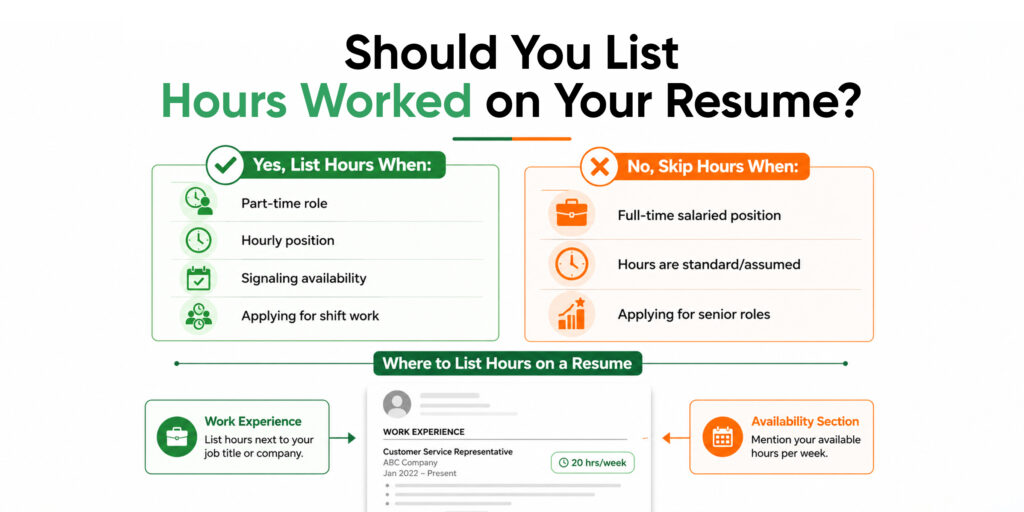
This is where a lot of job seekers hesitate. The short answer: it depends on the role. Listing your hours worked makes sense when a job is built around shift coverage, part-time availability, or on-call rotations. It’s less necessary for salaried, full-time roles with a standard daytime schedule, where “full-time” already tells the employer what they need to know.
If you’re applying for a job that specifically calls for evening or second shift hours, spelling out your availability up front saves everyone time and shows you’ve read the posting carefully.
Why to List Hours Worked on Resume
- It shows availability at a glance. Hiring managers screening for shift coverage can see immediately if your schedule fits.
- It signals flexibility. Noting weekend, evening, or on-call availability shows you’re open to hours other candidates might avoid.
- It supports productivity claims. For sales or project-based roles, listing hours worked can back up the results you’re claiming.
- It prevents mixed signals. Being upfront about your schedule avoids confusion later about interview times or start dates.
Where to List Hours Worked on Resume
You have three good options, depending on the situation:
- Work experience section: Note days and hours directly under a past or current role if the schedule is relevant to the job you’re targeting.
- A dedicated availability section: Useful if you’re job hunting for part-time, evening, or on-call work and want your schedule to stand out.
- Your cover letter: A good home for hours worked if the detail matters but doesn’t need permanent real estate on the resume itself.
How to List Availability and Hours on a Resume
Here’s what this looks like in practice.
Sales Representative Example
Sales Representative — XYZ Corporation, Anytown, USA. Worked Monday through Friday, 9 a.m. to 5 p.m., with occasional evening client events.
Availability Section Example
Availability: Available for interviews between 9 a.m. and 5 p.m. on weekdays. Able to work evening shifts and weekend events as needed
Keep it factual and specific. Avoid vague labels like “full-time” or “flexible” on their own; spell out the actual days and hours so a hiring manager doesn’t have to guess. And always be accurate. Overstating your availability to look more flexible can backfire fast once a schedule conflict comes up.
Examples of How to List Hours Worked on a Resume
Part-Time Retail Associate Worked Monday to Friday, 3 p.m. to 7 p.m.; Saturdays, 10 a.m. to 6 p.m.
Full-Time Project Manager Worked Monday to Friday, 9 a.m. to 5 p.m.; occasional evening meetings as needed.
On-Call Support Technician Available from 5 p.m. to 8 a.m., every third day. Monitored critical systems, responded to alerts, and resolved issues to maintain uptime overnight.
These formats work because they answer the exact question a hiring manager is asking: “Can this person cover the hours we need?” If you’re building out a full work history and want more guidance on presenting past roles clearly, this breakdown of how to show promotions on a resume covers how to structure experience entries so your growth and responsibility come through clearly.
Conclusion
Evening shift hours aren’t going anywhere. As more industries stretch their operating hours, employers need candidates who can speak clearly about their schedule and availability. Whether you’re applying for a second shift factory role or a part-time evening position in retail, being specific about your hours worked, rather than vague, is what gets you noticed.
Once your shift details are sorted, the rest of your resume needs to hold up too. Check out this guide to resume layouts and formatting to make sure your structure is ATS-friendly, or browse resume objective examples if you’re still working on your opening statement. When you’re ready to put it all together, this free resume builder with AI suggestions gives you the templates you need to build a resume that fits your schedule and your career goals.
FAQs
What time is the evening shift usually?
Most evening shifts run from 2 p.m. or 4 p.m. until midnight or 1 a.m., though exact hours vary by employer and industry.
Should I list my availability on my resume?
List it if you’re applying for part-time, shift-based, or on-call work. It’s less necessary for standard full-time salaried roles.
What’s the difference between the evening shift and the night shift?
Evening shift hours generally end around midnight, while night shift hours run from around midnight into the early morning.
Do evening shift workers get paid more?
Not always. Shift differential pay is up to the employer, though many companies offer a premium since evening and night hours are harder to staff.
How do I answer interview questions about shift availability?
Be direct about what hours you can and can’t work, and be upfront early in the process rather than after an offer is made.
- What Are Evening Shift Hours?
- Common Types of Work Shifts
- Evening Shift vs Night Shift: What’s the Difference?
- Industries That Commonly Use Evening Shifts
- Should You List Hours Worked on Your Resume?
- Why to List Hours Worked on Resume
- Where to List Hours Worked on Resume
- How to List Availability and Hours on a Resume
- Examples of How to List Hours Worked on a Resume
- Conclusion
- FAQs
- What time is the evening shift usually?
- Should I list my availability on my resume?
- What’s the difference between the evening shift and the night shift?
- Do evening shift workers get paid more?
- How do I answer interview questions about shift availability?