- Where Should Your Education Go on a Resume
- What Details to Include in the Education Section
- How to List Incomplete or Ongoing Education
- If You’re Still Studying
- If You Didn’t Complete Your Degree
- How to List Multiple Degrees on a Resume
- How to List Certifications and Licenses
- How Should You Address Gaps in Your Education?
- Resume Length and Space Constraints
- White Space on Your Resume
- One-Page Resume
- Tailor Your Resume
- Resume Length Guidelines
- What’s the Ideal Resume Length?
- Should You Include High School Education?
- How to List Online Degrees or Courses
- Common Mistakes to Avoid When Listing Education
- Final Thoughts: Listing Education on a Resume
Knowing how to list education on a resume can make a bigger difference than you think. Place it in the wrong spot or leave out key details, and hiring managers may miss qualifications that matter.
An advanced resume builder can automatically organize your resume and place each section in the right order. Still, knowing what belongs in your education section helps you customize your resume for different jobs and catch mistakes before you apply.
This guide explains how to list education on a resume, where to place it, what information to include, and how to format different education scenarios. You’ll also find practical resume education examples.
Where Should Your Education Go on a Resume
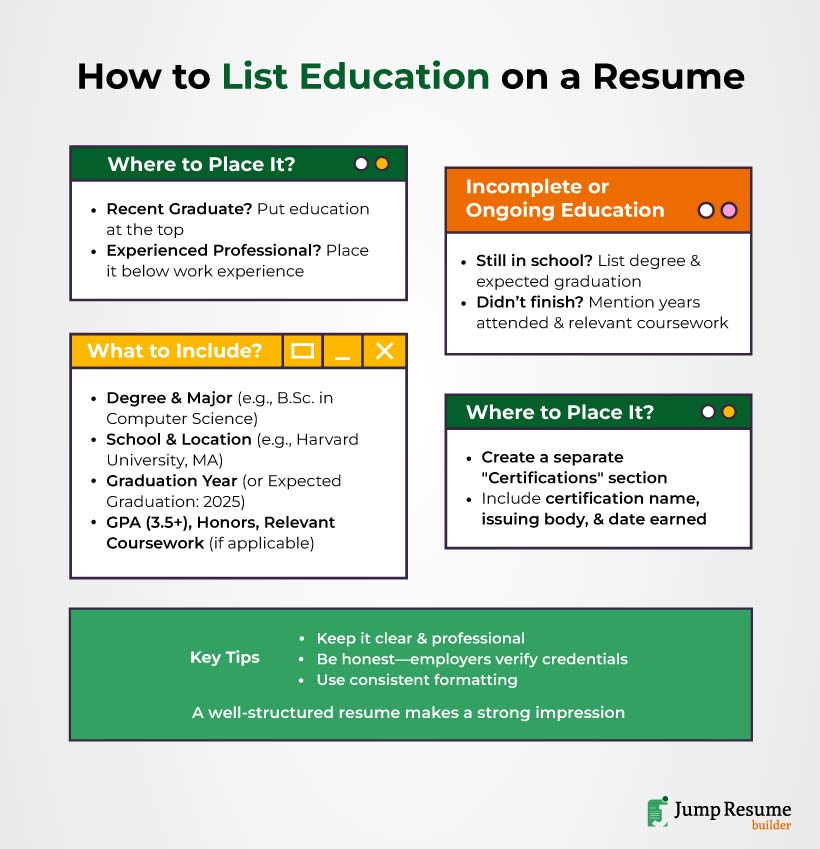
The right place for your education section depends on your experience. If you’re a student or recent graduate, place it near the top of your resume. Include relevant coursework, honors, or GPA if they strengthen your application (more on this later).
If you have several years of relevant work experience, list it below your work history. Your accomplishments and skills should take priority.
What Details to Include in the Education Section
The education section of your resume should include the details employers need to understand your academic background. Start with the essentials, then add extra information if it strengthens your application.
Include the following in your education section:
- Degree or qualification (Bachelor’s, Master’s, Associate’s, or Diploma)
- Major or field of study
- School, college, or university name
- Graduation year or expected graduation date if you’re still studying
- GPA (if it’s 3.5 or higher and relevant to the role)
- Academic honors or awards, such as Dean’s List or Magna Cum Laude
- Relevant coursework, especially if you’re a student or recent graduate with limited work experience
If your degree is directly related to the job you’re applying for, consider adding relevant coursework, honors, or certifications to strengthen your qualifications.
Quick insight: Furthermore, if you are applying for an entry-level job, you can include relevant coursework to show your knowledge in the field.
How to List Incomplete or Ongoing Education
You can still include your education on a resume, even if you haven’t graduated yet. The key is to present your current status clearly and accurately.
If You’re Still Studying
List your degree, school name, and expected graduation date. This lets employers know you’re actively working toward your qualification.
Example:
| Bachelor of Science in BiologyUniversity of CaliforniaExpected Graduation: May 2027 |
If You Didn’t Complete Your Degree
Include the school name, the years you attended, and the degree or program you studied. If you completed coursework that’s relevant to the job, you can list it below your education.
Example:
| Bachelor of Science in Computer ScienceUniversity of Texas2022–2024Relevant Coursework: Data Structures, Database Systems, Web Development |
How to List Multiple Degrees on a Resume
If you have more than one degree, list them in reverse chronological order. Start with your most recent or highest qualification, followed by your earlier degrees.
Include the same details for each degree:
- Degree name
- Major or field of study
- School or university name
- Graduation year
Example:
| Master of Business Administration (MBA) University of Michigan | 2024Bachelor of Science in Business Administration University of Florida | 2021 |
How to List Certifications and Licenses
When adding certifications and licenses to your resume, it is important to list them clearly.
First, create a separate section called “Certifications” or “Licenses.” This helps employers find them easily.
For each certification, include:
- Certification name
- Issuing organization
- Date earned
- Expiration date (if applicable)
Example:
| Project Management Professional (PMP)Project Management Institute (PMI)Issued: June 2024Expires: June 2027 |
How Should You Address Gaps in Your Education?
Education gaps don’t have to hurt your resume. They key is to present them honestly.
If you took time off to work, volunteer, or serve in the military, include that experience in your resume. This shows that you were still learning and gaining skills. Additionally, prepare to discuss these gaps in your cover letter or during an interview.
Employers like to see that you used your time well.
Resume Length and Space Constraints
Your education section should support your resume, not take it over. Keep it clear, easy to scan, and include only the details that add value to your application.
White Space on Your Resume
Use consistent fonts, spacing, and line breaks to improve readability. A clean layout helps hiring managers quickly find your education, work experience, and skills.
One-Page Resume
If you’re a student, recent graduate, or have less than 10 years of experience, a one-page resume is usually the best choice. Keep your education section brief and focus on the qualifications that matter most.
Tailor Your Resume
Customize your education section for each application. Include relevant coursework, academic projects, or honors only if they support the job requirements. Remove details that don’t add value.
Resume Length Guidelines
Your resume length depends on your experience level:
- Students and recent graduates: 1 page
- Mid-level professionals: 1–2 pages
- Senior professionals: Up to 2 pages, if every section is relevant
What’s the Ideal Resume Length?
For most job seekers, the ideal resume length is one page. If you have extensive experience, a two-page resume is acceptable. Regardless of the length, keep your education section concise, well-organized, and easy to read.
Should You Include High School Education?
If you have a college degree, you do not need to list your high school. However, if high school is your highest level of education, you should include it. You can add any honors or important coursework.
How to List Online Degrees or Courses
Online degrees and courses should be listed just like traditional ones. Write the school name and completion date. If needed, you can mention that it was an “Online Program.” This is helpful if the school is well-known.
Example:
| University of California, BerkeleyBachelor of Science in Business Administration (Online Program)Completed: May 2023 |
Common Mistakes to Avoid When Listing Education
Many people make mistakes when listing education.
Small mistakes in your education section can make your resume harder to read. Before you apply, check for these common issues:
- Listing education in the wrong order. Always start with your most recent or highest qualification.
- Including outdated information. If you have a college degree, you usually don’t need to include your high school education.
- Using incorrect graduation dates. Be honest about your graduation year or expected graduation date.
- Adding irrelevant details. Include coursework, GPA, or honors only if they strengthen your application.
- Using inconsistent formatting. Keep the same font, spacing, and date format throughout your resume.
Suggested read: Resume Layout: Examples and Best How-To Tips
Final Thoughts: Listing Education on a Resume
Organize your education section properly to help hiring managers quickly understand your qualifications. Whether you’re a student, recent graduate, or experienced professional, a clear and well-organized education section can strengthen your application and make your resume easier to review.
Before you apply, make sure your education details are accurate, relevant, and tailored to the job. A few small updates can make a big difference in how your resume is presented.
Ready to get started? Create your resume with our professional resume builder today.
- Where Should Your Education Go on a Resume
- What Details to Include in the Education Section
- How to List Incomplete or Ongoing Education
- If You’re Still Studying
- If You Didn’t Complete Your Degree
- How to List Multiple Degrees on a Resume
- How to List Certifications and Licenses
- How Should You Address Gaps in Your Education?
- Resume Length and Space Constraints
- White Space on Your Resume
- One-Page Resume
- Tailor Your Resume
- Resume Length Guidelines
- What’s the Ideal Resume Length?
- Should You Include High School Education?
- How to List Online Degrees or Courses
- Common Mistakes to Avoid When Listing Education
- Final Thoughts: Listing Education on a Resume